What Is SMED Training? Guide to Setup Time Reduction Training
What Is SMED Training?
In the world of production, speed is synonymous with efficiency. But the lost time when machines stop while changing from one product to another is a hidden cost leak for many companies. This is where SMED trainingcomes in, to minimize setup times, one of the biggest wastes on the shop floor.
In this guide prepared by Gembapartner, we will cover in full detail what SMED training is, what it will bring to your business and how this discipline is applied.
What Is SMED? (Single Minute Exchange of Die)
SMED stands for Single Minute Exchange of Die and is translated as “changing dies in single-digit minutes.” This methodology was developed by Shigeo Shingo within the Toyota Production System.
The expression “single minute” here represents the goal of bringing a die or model changeover time below 10 minutes (that is, between 1 and 9 minutes) . SMED is an improvement system focused on radically shortening the time between the last good part of one run and the first good part of the next different model.
What Does SMED Training Aim For?
SMED training does not only teach a technique; it gives the production team a “time management” vision. The core aims of this training are:
-
Reducing Downtime: Increasing production capacity by minimizing the time machines sit idle.
-
Enabling Small-Batch Production: When setup times shorten, companies can produce small quantities with frequent changeovers according to customer demand instead of holding large inventories.
-
Increasing Flexibility: Gaining the ability to respond quickly to sudden changes in market demand (different product requests).
-
Minimizing Human Error: Reducing setup errors and initial scrap rates through standardized changeover processes.
Who Is SMED Training Suitable For?
In an organization aiming for operational excellence, SMED training should not be limited to engineers. This training is ideal for the following groups:
-
Production and Plant Managers: For strategic planning and capacity management.
-
Production Engineers and Methods Specialists: For process improvement and standard work design.
-
Maintenance Team and Technicians: To carry out technical modifications on equipment.
-
Team Leaders and Operators: Because they are the people who carry out changeovers on the shop floor and generate practical ideas to shorten the time.
What Does SMED Training Content Include?
A comprehensive SMED training should go beyond theoretical knowledge and include shop floor practice and analysis techniques.
Defining Internal and External Setup Operations
The cornerstone of the training is separating operations into two:
-
Internal Setup: Operations that can only be done when the machine is stopped (for example, removing the die).
-
External Setup: Operations that can be done while the machine continues to run (for example, bringing the next die, preparing hand tools).
How Is Setup Time Analysis Done?
In the training, participants are taught how to measure the current state. The current “lost time” is mapped with video analysis, spaghetti diagrams and stopwatch measurements. Which step takes how long and which are waste is determined at this stage.
Techniques for Shortening Setup Time
The technical part of SMED training covers the following improvement steps:
-
Externalization: Converting internal setup steps into external setup (preparing while the machine is running).
-
Improving Fasteners: Using latches, wedges or quick-connect fixtures instead of screws.
-
Eliminating Adjustments: Using stoppers and digital indicators that end trial and error.
-
Parallel Work: Two or more operators working in sync to divide the time.
Benefits of SMED Training for Businesses
Projects implemented after the training are directly reflected in the company’s balance sheet:
-
Lower Costs: It means less downtime, less labor cost and less energy waste.
-
Reduced Inventory Costs: Because quick changeovers are possible, the need to hold “safety stock” decreases and warehouse space is freed.
-
Delivery Performance: Responding to customer orders in much less time improves “Lead Time.”
-
Occupational Health and Safety: Because complex and heavy setup processes are made simpler and more ergonomic, the risk of workplace accidents decreases.
Gains After SMED Training
When the training is completed, participants have the following competencies:
-
They can analyze setup processes with scientific methods.
-
They can develop low-cost improvement ideas (Kaizen) for the equipment in their own work areas.
-
By creating standard work forms, they ensure the changeover is done at the same speed every time.
-
As part of a continuous improvement culture, they can track productivity data.
The Relationship Between SMED Training and Lean Manufacturing
SMED is one of the most critical stones of the Lean Manufacturing pyramid. SMED applies the principle of “eliminating waste,” the main goal of lean manufacturing, most clearly on a time basis.
In particular, for the JIT (Just-In-Time Production) system to work, SMED is a necessity. If changing a machine’s setup takes hours, “flow” cannot be achieved in that factory and it reverts to mass production. SMED training removes the “setup and changeover” obstacle in front of flow.
What Should You Pay Attention to When Getting SMED Training?
For the training to be effective, the following factors should be considered:
-
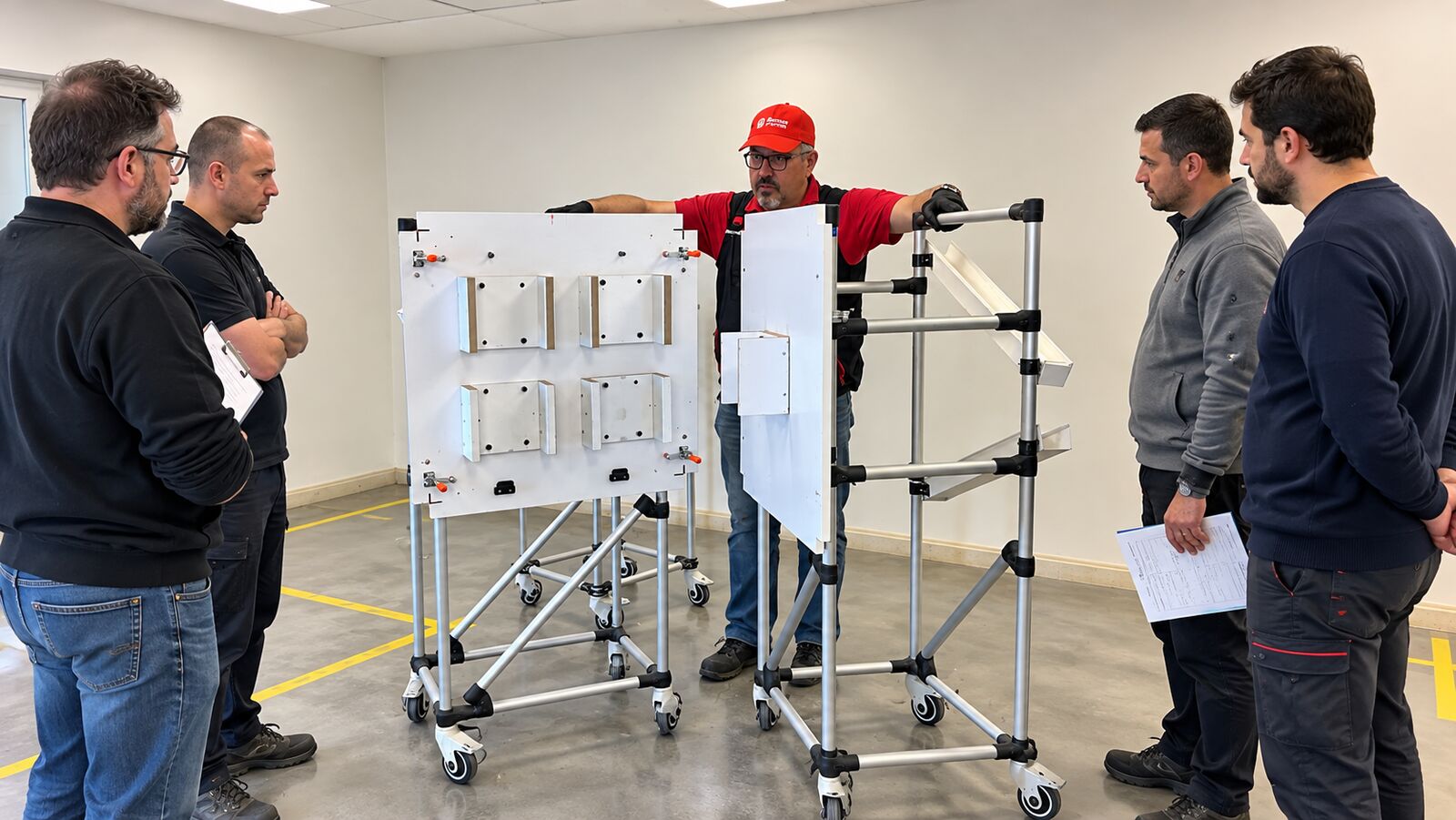
It Must Be Hands-On on the Shop Floor: A SMED training taught only in the classroom will not last. A “Pilot Implementation” must be done at a machine.
-
Measurable Targets: A clear goal, such as reducing a setup time by X%, should be set at the end of the training.
-
Team Dynamics: People from different departments (Production, Maintenance, Quality) should be encouraged to work together in the training.
-
Continuity: SMED is not something done once and forgotten. The training should emphasize making it a culture.
Frequently Asked Questions About SMED Training (FAQ)
How many days does SMED training take?
It generally takes between 2 and 3 days, including basic theoretical training and a pilot implementation. This may vary according to the company’s complexity.
Can SMED training be given online?
Theoretical parts can be given online, but the essence of SMED is observation on the shop floor (Gemba). Therefore, hybrid or face-to-face, practice-supported trainings have a much higher success rate.
Is a certificate given after SMED training?
Yes, professional training institutions like Gembapartner present a certificate of achievement to participants who successfully complete the training and take part in pilot projects.
SMED training is the most concrete step toward shedding production sluggishness and becoming an agile organization. Learning the right methodology is critical to discovering your equipment’s potential and turning your downtime into profit.