How to Set Up Daily Operational Control with Asakai Meetings
How do you set up daily operational control with asakai meetings? Indicator selection, board, agenda, roles and common mistakes. A Gemba Partner guide.
Short answer: To set up daily control with an asakai meeting, first choose 4-6 daily indicators, prepare a visual board on the shop floor, set a fixed time and a fixed agenda, define roles and action follow-up, and keep the meeting short. In the first weeks, discipline matters more than the meeting itself.
Introduction
We know the concept of asakai: a short, daily meeting held on the shop floor. The question is: how do you make it work in your own factory? Many companies start the meeting, but after a few weeks it either drags on, turns into a data debate, or is quietly abandoned.
In this guide, we walk step by step through the meeting that establishes daily operational control. For the definition of the concept, you can first read our article What is Asakai
Step 1: Choose the Right Indicators
The quality of the meeting depends on the quality of the indicators. Too many indicators scatter the focus. Generally, 4-6 indicators that can be tracked daily across safety, quality, delivery, productivity and cost are enough.
- Safety: Number of accidents and near misses
- Quality: Defect and rework rate
- Delivery: Schedule adherence, late orders
- Productivity: Output quantity, OEE
For each indicator, the target, the measurement method and the person responsible for measurement must be clear.
Step 2: Prepare a Visual Board on the Shop Floor
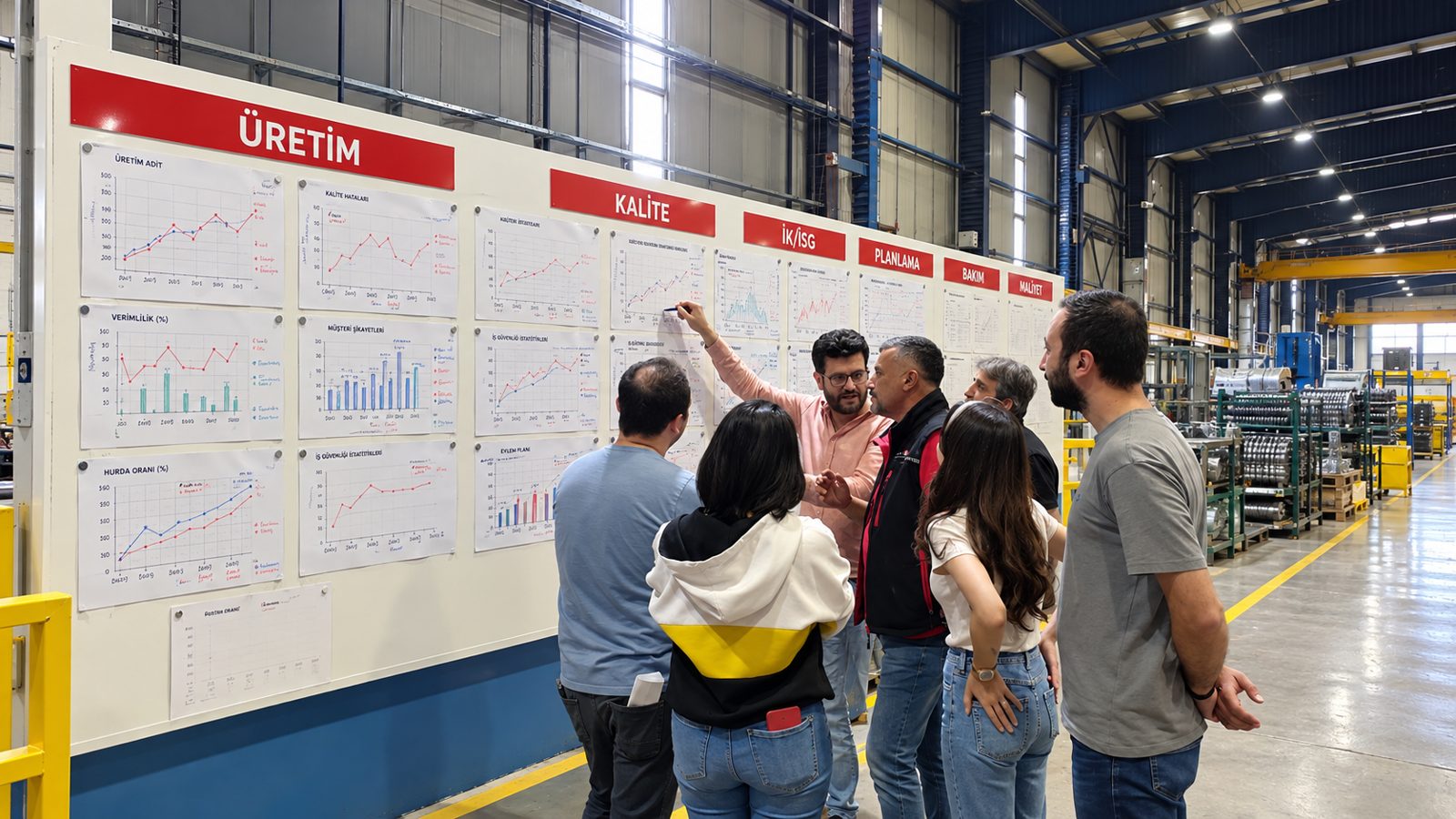
The board is the center of the meeting. Targets and actuals, deviations and open actions should be visible in one place. Color coding (green for hitting the target, red for deviation) tells the status at a glance. The board should be located where the work is done, not in the office.
Step 3: Fix the Time and the Agenda
The meeting should start at the same time every day and the agenda should not change. Recommended flow:
- Safety and previous day’s results
- Indicators deviating from target and brief reasons
- Today’s risks (material, equipment, personnel)
- Follow-up of open actions
- Issues to escalate to the next level
Set a short duration for the meeting (usually 10-15 minutes) and hold it standing. Topics that require long discussions are handled separately with the relevant people after the meeting.
Step 4: Define Roles and Action Follow-Up
- Meeting leader: Usually the department supervisor; manages the flow and the time.
- Data owners: The people who keep the indicators up to date.
- Action owners: Each action has a single owner and a due date.
Actions should remain visible on the board and be reviewed in every meeting until completed. Start a root cause study for recurring problems. In these efforts, problem-solving coaching can help.
Step 5: Establish an Escalation Path
Problems that cannot be solved within the department should be taken to a higher-level meeting. Define the escalation rule in advance (for example, “if the same problem continues three days in a row”). This way, problems do not get stuck on the shop floor.
Common Mistakes
- Moving the meeting to a meeting room and detaching it from the shop floor
- Tracking too many indicators
- Not assigning owners and dates to actions
- Getting into root cause analysis during the meeting and letting it run long
- Lack of regular management participation to support the meeting
- Using a blaming tone toward the person who brings up a problem
Sample Asakai Flow: A 12-Minute Plan
The flow below is an example for a production department. You can adapt it to your own business.
| Time | Topic | Owner |
|---|---|---|
| 0-2 min | Safety: accidents, near misses, today’s risks | Meeting leader |
| 2-5 min | Yesterday’s results: quality, delivery, productivity | Data owners |
| 5-8 min | Deviations and brief reasons | Relevant owners |
| 8-10 min | Today’s plan and risks | Planning, maintenance |
| 10-12 min | Action follow-up and escalation | Meeting leader |
Implementation Plan for the First 30 Days
- Week 1, preparation: Select the indicators, set up the board, determine the meeting time and leader, and explain the purpose to the team.
- Week 2, launch: Start the meeting. The goal is not perfect data but establishing meeting discipline. Keep the time under control.
- Week 3, improvement: Simplify the board and indicators based on feedback. Tighten action follow-up.
- Week 4, sustaining: Operate the escalation rule and get top management to attend the meeting occasionally.
Behavior Rules for the Meeting Leader
- Starts and ends the meeting on time.
- Does not blame the person who brings up a problem; encourages them to take ownership of it.
- Steers the discussion not toward the cause of the problem, but toward the owner and the date.
- Makes sure every action has an owner and a date.
- Sets an example on the indicators themselves.
How Do You Measure Success?
The meeting itself must also be measured. Simple indicators are enough: adherence to meeting time, attendance rate, on-time action closure rate and number of recurring problems. If these indicators are improving, your daily management system is maturing. For indicator design, see our field management and development system page.
Conclusion
Daily operational control is built with the right indicators, a visual board, a fixed agenda and clear ownership. In the first weeks, the goal is not to hold a perfect meeting but to establish discipline. A short, regular meeting that makes problems visible changes the team’s work culture over time.
At Gemba Partner, we set up daily management systems together with teams on the shop floor. For details, see our field management and development system page or contact us.
Frequently Asked Questions
When should the asakai meeting be held?
It should be held at the same time every day, preferably at the start of the shift. A fixed time turns the meeting into a habit.
Which indicators should be tracked for asakai?
Generally, 4-6 indicators that can be tracked daily across safety, quality, delivery, productivity and cost are enough. As the number of indicators grows, the meeting loses focus.
What should be done if the meeting runs long?
Topics that require root cause analysis should be taken out of the meeting and moved to separate problem-solving sessions; in the meeting, only the problem definition, owner and date should be set.
Should a digital board or a physical board be used?
Either can be used. What matters is that the data is current, visible on the shop floor and accessible to everyone. A common path is to establish discipline with a physical board first and then move to digital.
How is asakai done in multi-shift operations?
A short meeting can be held at the start of each shift. A shared board is used and shift handovers are kept visible on the board. This way, the previous shift’s problems are passed on to the next shift.
Is a digital system required to start asakai?
No. Starting with a physical board is often easier. Once discipline is established, you can move to digital tools.