What Is Asakai? Purpose and Benefits of the Morning Meeting in Lean Management
What is asakai (the morning meeting) and what is it for? The purpose, agenda and benefits of the short daily meeting in Japanese lean management. Gemba Partner guide.
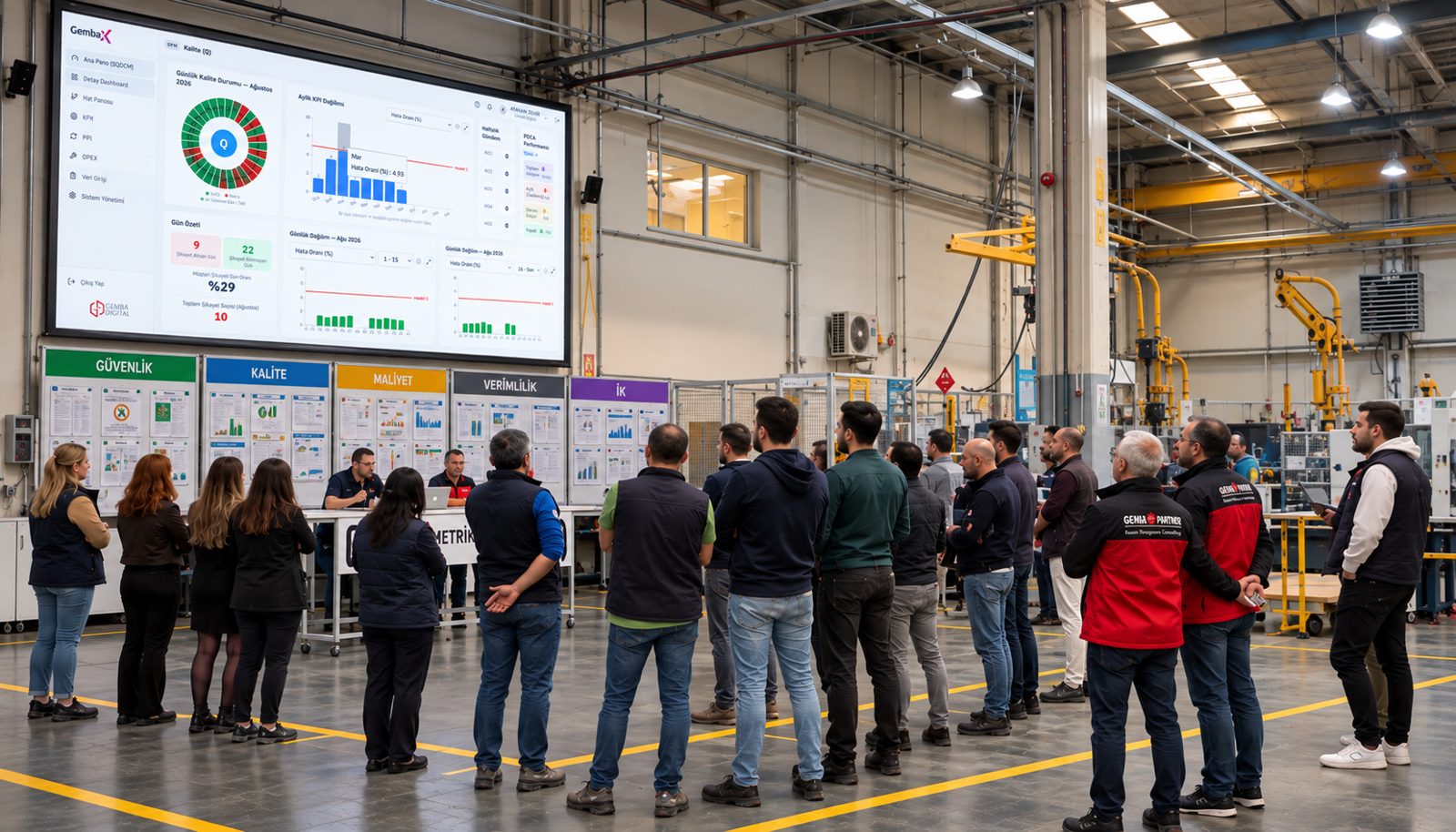
Short answer: Asakai means “morning meeting” in Japanese. In lean management, asakai is a daily management meeting in which the team gathers at the same time every day, usually standing and briefly, to review the previous day’s performance, the problems that arose and today’s priorities.
Introduction
In many businesses, meetings are long, the agenda is scattered and in the end it is unclear who will do what. Asakai aims for the opposite: a short, floor-level, data-driven and action-oriented daily rhythm.
In Japanese, asa means morning, kai means meeting. In this article we cover what asakai is, which questions it seeks to answer, how it differs from classic meetings and under which conditions it works. To learn how to set up the meeting step by step, see our guide How to Set Up Asakai Meetings and Daily Operational Control which covers it in detail.
What Is the Purpose of an Asakai Meeting?
The core purpose of asakai is to make problems visible at the start of the day, not during it. This way a problem is assigned to an owner before it grows, root cause investigation starts and the team begins the day with the same information.
- Transparency: Yesterday’s results are shared on a board everyone can see.
- Fast response: If there is a deviation, action is taken the same day.
- Ownership: Every action has an owner and a date.
- Team alignment: Production, maintenance, quality and logistics look at the same priorities.
Which Questions Does an Asakai Meeting Seek to Answer?
The meeting usually follows a fixed flow. Although practices vary from business to business, a typical agenda is as follows:
- What happened yesterday in the safety, quality, delivery and productivity indicators?
- What is the cause of indicators that deviate from target?
- Is there anything in today’s plan that creates risk (materials, equipment, personnel)?
- What is the status of open actions, and which are overdue?
- Which topics should be escalated to a higher level?
Root cause analysis is not carried out in the meeting. The aim is to define the problem, identify its owner and, if necessary, plan a separate problem-solving session.
Differences Between Asakai and a Classic Meeting
| Topic | Classic meeting | Asakai |
|---|---|---|
| Duration | Long and undefined | Short and fixed (usually 10-15 minutes) |
| Location | Meeting room | On the floor, in front of the board where the indicators are |
| Data | Narrative-heavy | Visual board and measurable indicators |
| Output | Vague decisions | Actions with an owner and a date |
| Frequency | Irregular | Every day at the same time |
Under Which Conditions Does Asakai Work?
On its own, asakai is not a tool; it is part of the daily management system . Without defined indicators or data collection on the floor, the meeting turns into a chat. It is most beneficial under these conditions:
- Clear indicators that can be tracked daily are defined
- Participants have decision-making authority
- Top management supports the meeting and there is a culture where whoever raises a problem is not punished
- Actions are always reviewed at the next meeting
For the indicator and visual board infrastructure, you can explore our visual management and field management and development system pages.
The Origin of Asakai and Its Place in Lean Management
The morning meeting is a common management habit in Japanese companies. In the lean management approach, asakai is treated as a part of the daily management system framework. Daily management is the structure in which indicators, visual boards, standard work and action tracking work together. Asakai is the “meeting point” of this structure: indicators are reviewed, deviations are discussed and actions are assigned.
For this reason, asakai should be seen not as a standalone meeting technique but as the rhythm mechanism of floor-level management. For the overall framework of lean transformation, take a look at our article What Is Lean Transformation for the big picture.
What Should Be on an Asakai Board?
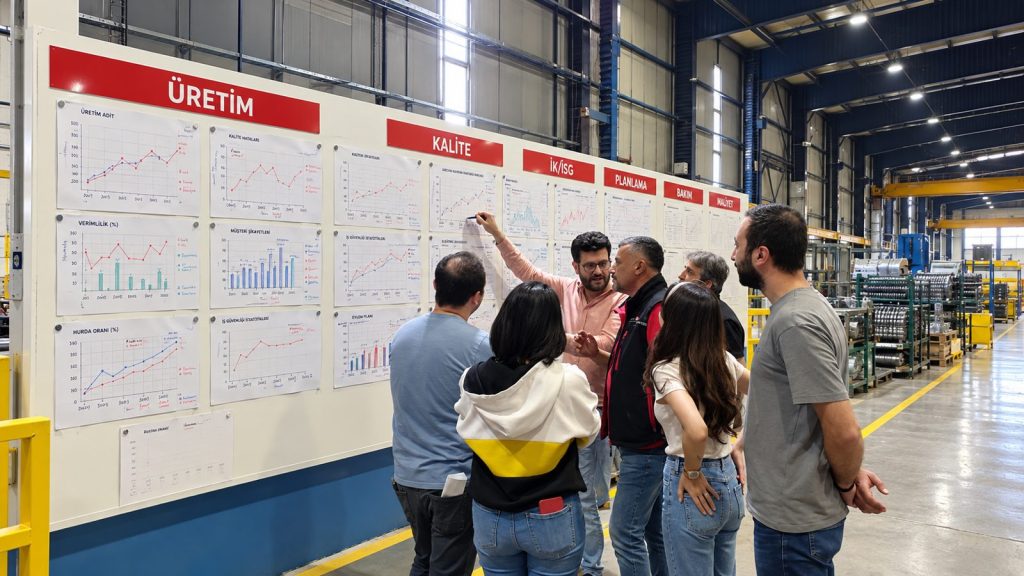
A good board turns the meeting from a chat into one based on information. The following elements usually appear on the board:
- Indicators: Target and actual values for safety, quality, delivery, productivity and cost.
- Trend charts: The course of recent days or weeks, not just a single day.
- Deviation notes: A short reason for indicators moving away from target.
- Action list: What will be done, who will do it and by when.
- Escalation area: Topics to be taken to a higher level.
The board should be kept simple. Too much information breaks the focus of the meeting. For the logic of visual boards, see our article Visual Management in Business for more.
The Difference Between Asakai and an Agile Daily Stand-up
Asakai resembles the daily stand-up in the software world: short, regular and on your feet. However, their focus differs.
| Topic | Asakai | Daily stand-up |
|---|---|---|
| Focus | Indicator performance and deviations | Team members’ task status |
| Data | Measurable indicators on the board | Task board |
| Location | Usually on the floor, where the work is done | The team’s workspace or online |
| Output | Problem owner and action | Making blockers visible |
Why Does Asakai Fade? Early Warning Signs
- The meeting turns into storytelling instead of indicators.
- Attendance drops and decision-makers do not come.
- Most actions are still open at the next meeting.
- The data on the board is not up to date.
- The meeting keeps getting longer.
When any of these signs appears, the meeting should not be abandoned; the board, the indicators and the role of the meeting leader should be reviewed again.
Conclusion
Asakai is not a complicated method but a disciplined habit. A team that gathers at the same time every day, at the same board, with the same questions, catches problems early rather than late. Over time this rhythm becomes the backbone of operational control.
At Gemba Partner, we build the daily management system on the floor together with businesses. If you would like to discuss the right structure for you, contact us..
Frequently Asked Questions
What does asakai mean?
Asakai means morning meeting in Japanese. In lean management, it refers to the daily meeting in which the team gathers briefly every day to review performance and problems.
How many minutes should an asakai meeting last?
Although practices vary, keeping the meeting short is essential. Usually 10-15 minutes is targeted. If it runs long, topics should be moved to separate problem-solving sessions.
Who should attend an asakai meeting?
The leaders of functions that affect daily performance, such as production, maintenance, quality and logistics, attend. Having people who can make decisions is important for the meeting’s effectiveness.
What is the difference between asakai and daily management?
Asakai is the meeting part of the daily management system. Daily management is a broader structure that also covers indicators, visual boards, standard work and action tracking.
Is asakai done only in production?
No. It can also be applied in logistics, maintenance, quality and even office functions. What matters is having indicators that can be tracked daily and a short meeting rhythm.
What is the relationship between asakai and the gemba walk?
Asakai reviews daily performance. A gemba walk is a manager going to the floor to observe the process. The two complement each other: a deviation seen in asakai can be examined on the spot in a gemba walk.