What Is Muda? The 7 Types of Waste in Lean Production and How to Eliminate Them
What is muda (waste)? Learn the 7 types of waste in lean production with factory examples and the steps to eliminate waste. Gemba Partner guide.
Short answer: Muda means “waste” in Japanese. In lean production, muda is any activity that adds no value to the product or service and that the customer is not willing to pay for. The Toyota Production System defines seven core types of waste: overproduction, waiting, unnecessary transport, over-processing, excess inventory, unnecessary motion and defective products.
Introduction
Everyone working in a factory says they are busy. But being busy does not mean creating value. When you look at the production time of a product, it is common to see that most of that time is spent waiting, moving, searching and correcting. This is exactly the starting point of lean thinking: being able to separate value-adding work from non-value-adding work.
In Japanese, muda (無駄) means “waste, futile effort.” In this article we cover what muda is, the seven types of waste with real floor examples, ways to make waste visible and steps to eliminate it. For the general framework of lean production, see our article What Is Lean Production as well.
Muda, Mura and Muri: Three Sources of Loss
In the Toyota Production System, losses are handled under three headings. Muda is waste itself. Mura is imbalance and fluctuation, that is, overload one day and idle capacity the next. Muri is the overburdening of people or equipment. The three feed each other: an unbalanced workload (mura) strains people (muri), and a strained process produces defects and waiting (muda).
When fighting waste on the floor, looking only at muda is not enough. The root cause is often found to lie in an unbalanced plan or an overloaded station.
The 7 Types of Waste in Lean Production
The seven types of waste defined by Taiichi Ohno are still the most practical way of classifying losses in factories today.
| Type of waste | Factory example | Typical sign |
|---|---|---|
| 1. Overproduction | Stamping parts before an order arrives or before they are needed | Piles of intermediate stock, full shelves |
| 2. Waiting | An operator waiting for material, a die or approval | Idle machines, idle staff |
| 3. Unnecessary transport | A part being moved by forklift between lines again and again | Long material paths, many handoffs |
| 4. Over-processing | Processing to a precision the customer did not ask for, double checks | Unnecessary approval steps, tolerances tighter than needed |
| 5. Excess inventory | Holding raw material and work in progress beyond need | Full warehouses, aging products, tied-up cash |
| 6. Unnecessary motion | An operator having to search for tools, bend or reach | Disorganized workspace, ergonomic complaints |
| 7. Defects and rework | Scrapping or reworking a defective part | High scrap and rework rates |
Many sources add an eighth waste to these: unused human potential. Not listening to employees’ ideas and leaving improvement suggestions without an owner is one of the most expensive wastes in the long run.
Making Waste Visible: Where to Start?
Waste often goes unnoticed because it has become a habit. The basic methods used to make it visible are the following:
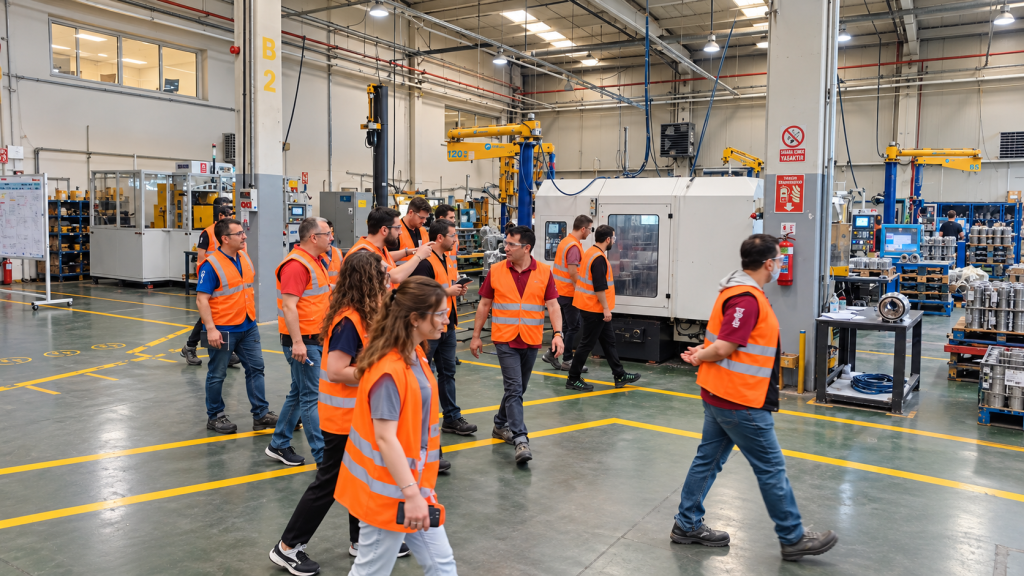
- Gemba walk: Going to where the process happens and watching the work. Observation instead of reports is the fastest way to find waste.
- Value stream mapping: Drawing the whole flow from raw material to shipment, with value-adding and non-value-adding times. For details, see our article Value Stream Map (VSM) on the subject.
- Spaghetti diagram: Showing unnecessary motion and transport by drawing the path an operator or material follows during the day.
- 5S and visual management: An orderly area makes abnormalities instantly visible. See Visual Management in Business.
Five Steps to Eliminate Waste
- Define value from the customer’s perspective. What is the activity the customer is willing to pay for?
- Map the current flow. Classify every step as value-adding, necessary but non-value-adding, or pure waste.
- Pick the biggest waste first. Trying to solve everything at once ends with solving nothing.
- Find the root cause and improve with small experiments. Asking “why” again and again lets you solve the cause, not the symptom. For the kaizen approach, see our article What Is Kaizen on the subject.
- Standardize and sustain the new method. An improvement that is not standardized reverts to its old state within a few weeks.
With pull systems (for example kanban) overproduction and excess inventory can be reduced directly, and with quick changeover work (SMED) waiting and batch-size problems can be reduced directly.
Common Mistakes in Fighting Waste
- Looking for waste only on the production line. Waiting, unnecessary approvals and errors exist in exactly the same way in office processes.
- Focusing only on cost reduction. The goal is not to squeeze people but to make work flow.
- Not making improvements together with the people on the floor. The operator knows the process best.
- Cleaning up once and leaving it. Waste is a problem that keeps being born again.
Does Muda Occur Only in the Factory? Examples from Different Areas
The concept of waste is not limited to the production line. The same logic applies in the warehouse, the office and service processes. As the process changes, the appearance of waste changes, but its essence stays the same: work that adds no value for the customer.
- Production: Making parts when the next station is not ready, waiting for a die change, sorting out defective parts.
- Warehouse and logistics: Handling the same product more than once, unnecessary shipment preparation, time spent on a product that cannot be found.
- Office processes: Entering the same data into multiple systems, multi-level approval chains, rework caused by unclear requests, unread reports.
- Procurement: Ordering more than needed and tying up stock, stopping production because of delivery delays.
That is why limiting waste analysis to the production floor alone misses a significant part of the losses. For the lean approach in office processes, you can also see our lean process analyses page.
Value-Adding and Non-Value-Adding Time: How Is Muda Measured?
To move from talking about waste to measuring it, the total time of a job must be divided into three categories:
| Category | Definition | Example |
|---|---|---|
| Value-adding | An operation the customer is willing to pay for that transforms the product | Machining, assembly, painting |
| Necessary but non-value-adding | Work that is mandatory under current conditions but does not create value | Legal inspections, mandatory preparation |
| Pure waste | Work with no justification that can be eliminated directly | Waiting, unnecessary transport, double checking |
When a value stream map is drawn, it is seen that a very large part of an order’s total waiting and flow time is spent mostly in non-value-adding steps. With a hypothetical example: if an order with a total lead time of 10 days has an actual processing time of a few hours, the rest is waiting, inventory and transport. The real improvement opportunity lies less in increasing processing speed than in shortening these waiting times.
Gemba Checklist for Waste Hunting
To see waste on the floor, ask yourself the following questions for each type of waste:
- Overproduction: Where does intermediate stock pile up? Who is producing ahead of the next station?
- Waiting: How many times and for what is the operator or machine waiting?
- Transport: How many times does the material get touched from one point to another, and how far does it travel?
- Over-processing: Is there an operation or check the customer did not ask for?
- Inventory: How long has the oldest stock been waiting? Why is the stock being held?
- Motion: How much does the operator walk or bend for tools or materials?
- Defects: What is the most frequently recurring defect and is its root cause known?
By using this list together on a gemba walk, you can help the team see waste through the same eyes.
Conclusion
Muda often hides on the factory floor in the guise of “normal work.” Recognizing the seven types of waste lets you know what to look for on the floor. Mapping the value stream, choosing the biggest loss, solving the root cause and standardizing the new method are what truly reduce waste permanently.
At Gemba Partner, we identify waste together with you on the floor in production and operations processes and turn it into lasting solutions. For our approach, you can see our lean production consulting page, and to work with us, get in touch.
Frequently Asked Questions
What does muda mean?
Muda means waste or futile effort in Japanese. In lean production, it refers to any activity that does not create value for the customer.
What are the 7 wastes in lean production?
Overproduction, waiting, unnecessary transport, over-processing, excess inventory, unnecessary motion and defects (rework). Many sources also add unused human potential as an eighth waste.
What is the difference between muda, mura and muri?
Muda is waste, mura is imbalance and fluctuation in workload, and muri is the overburdening of people or equipment. The three trigger each other and should be addressed together.
Where should I start looking for waste?
Start by going to where the process happens, that is, with a gemba walk. Then draw a value stream map, choose the biggest waste and solve it first.
Does muda occur in office and service processes too?
Yes. Unnecessary approval steps, re-entering the same data, rework due to unclear requests and waiting files are typical wastes of office processes.
Can muda be reduced to zero completely?
In practice the goal is to continuously reduce waste. Some non-value-adding work (for example legal requirements) is necessary under current conditions. What matters is to remove pure waste and also to reduce necessary but non-value-adding work over time.