Managing Hidden Costs in Production
Managing hidden costs in production: how much does your factory really consume by the end of a day? A lean cost reduction approach.
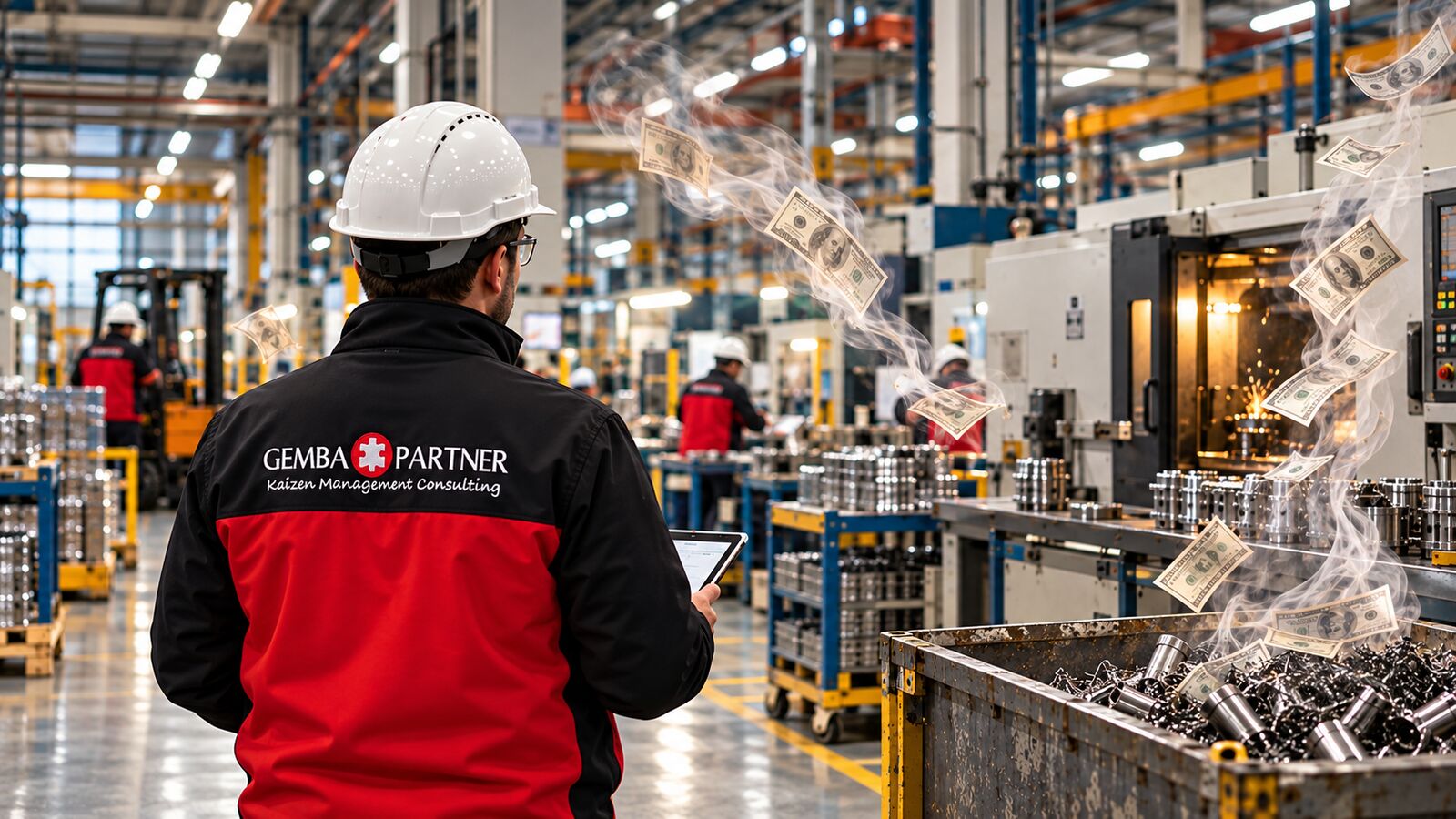
When buying a car, one of the first questions we ask is usually the same: “How much does it burn per 100 km?” Because as much as the purchase price, we want to know how much it will consume while we drive it. So why don’t we ask the same question of our factories? “How much did our factory consume today?”
Here we are not talking about electricity, natural gas or water consumption. We are talking about the resources and money we unknowingly consume while producing in production and operations processes. From a lean manufacturing and operational excellence (OPEX) perspective, the real question is not only how much we produce, but how many resources we consume while producing. This article explains why cost reduction in production starts with making losses visible.
Are Production Cost and Actual Operational Consumption the Same Thing?
Every company uses certain resources to carry out its production: people, machines, materials, energy, time and space. Let’s say these make up a production cost. For example, suppose we planned for our factory to use 1,000,000 TL of resources to achieve a certain daily output. At the end of the day, we reached the targeted production quantity. But did we really consume 1,000,000 TL? Or did we actually finish the day having consumed 1,100,000 TL because of the following losses that occurred during production?
- scrap and quality losses,
- waiting,
- unplanned machine downtime,
- rework and repair activities,
- unnecessary transport and motion,
- long set-up times,
- low machine and labor efficiency,
- overtime.
The 100,000 TL difference is not a cost that is necessary for production to take place. This difference is the cost of the operational losses occurring inside the processes.
Why Are Hidden Costs Dangerous?
One of the biggest obstacles to cost reduction in production processes is that not all losses appear under a single heading in financial reports. We may see the cost of scrap in one place, overtime in another and maintenance expenses in a different account. The cost created by waiting times, low cycle performance or unnecessary motion often cannot be seen directly.
As a result, loss costs are spread across different points of the organization, and hidden costs turn into unmanageable costs. Therefore, in a lean management approach, the first goal is not to cut costs immediately but first to make visible the operational reality that creates the cost.
Knowing the Standard Cost Is Not Enough; You Must Know the Cause of the Variance
Without correctly defining the factors that make up a product’s standard cost, it is hard to understand why the actual cost deviates from the standard. How much material should there be? How much direct labor should there be? How long should the machine run? How much time should be spent on set-up? At what cycle time should a product be produced? What is the expected scrap or quality level?
When we know these values, we can start to question the difference between standard and actual. For example, if an operation should consume 100 units of resources as standard but actually consumes 112 units, the real management question is: where are the extra 12 units we consumed? This question takes us directly to the shop floor.
The Starting Point of Kaizen: Making Consumption Visible
Kaizen is often perceived as collecting improvement ideas from employees or improvement projects carried out in certain periods. Yet the starting point of a kaizen culture is being able to see the current situation correctly: Where are we waiting? Where do we move too much? Where are we losing capacity? Where are we using more labor than needed? Which machine stoppages are increasing our production cost? Which quality problem creates rework? Which process creates more stock than necessary?
When these questions start to be answered, lean tools also start to reach their real purpose. The purpose of 5S, TPM, SMED, standard work, kanban, heijunka, OEE or problem-solving techniques is not merely to implement these systems in the factory. The aim is to eliminate the losses that cause production to consume more resources than necessary.
Productivity Gain Is Actually a Consumption Problem
Evaluating productivity only as “producing more” can be misleading. If a factory produced 1,000 units with 100 people yesterday and produces 1,100 units with the same resources today, productivity has increased. But if it can produce the same 1,000 units with less labor, shorter working time, less scrap, less stock and less overtime, productivity has also increased.
Therefore productivity improvement and cost reduction are not independent of each other. The fundamental approach of the Toyota Production System (TPS) and lean management is also not to increase production by using more resources, but to produce the same value by consuming fewer resources by eliminating muda. Real operational excellence is not only producing more, but consuming less while producing.
Cost Reduction Starts Not in the Finance Department but at the Gemba
When companies want to cut costs, one of the first reflexes is to review budgets, lower purchase prices or cut overheads. These are of course important; but for sustainable cost reduction, one needs to look at the production and operations processes themselves. Because the Gemba is where the factory makes or loses money every day.
A minute a machine waits, a material moved unnecessarily, a product reworked, labor used more than needed or production that could not be made because of unplanned downtime ultimately turns into economic value. Therefore shop floor management should not consist only of tracking SQCDM indicators. A good shop floor management system should also make visible the relationship between operational losses and financial results.
“How Many Units Did We Produce Today?” Is No Longer Enough
In traditional production management, at the end of the day we usually look at the production quantity: How many units did we produce today? This question is important but not sufficient on its own. Two factories producing the same output can consume completely different amounts of resources. One may produce with high stock, overtime, scrap, rework and unplanned downtime while the other reaches the same output with a much more controlled process. On paper, both produced the same amount; but their competitiveness is not the same.
Therefore we need a second question: “How much did we consume today to produce this output?” And then a third question must follow: “How much of this consumption was really necessary?” When these three questions start to be asked together, the concepts of lean manufacturing, kaizen and operational excellence stop being theoretical practices and are directly tied to the company’s financial performance.
Competitive Costs Are Won on the Shop Floor
A factory’s real competitiveness should be measured not only by how much it can produce but by how efficiently it can produce it. Scrap, waiting, excess stock, rework, unplanned downtime, low OEE, unnecessary motion and overtime are not just operational problems; each is a cost element affecting the company’s profitability.
Therefore the common goal of the Toyota Production System, lean manufacturing, kaizen and operational excellence efforts is not to apply more tools; it is to systematically reduce the unnecessary resource consumption of processes by making losses visible. Because competitive prices are not created only by decisions made in meeting rooms. Competitive costs are won on the shop floor.
Conclusion
Perhaps from now on we need to ask two questions side by side in production meetings: “How much did we produce today?” and “How much did we consume producing it?” If we do not know the answer to the second question, we do not yet fully know our real cost reduction potential.
To uncover the hidden costs in your factory together, see our lean process analysis service or get in touch with us.