What Is Just in Time Production?
What Is Just in Time Production?
One of the most radical ways to increase efficiency in the world of production is to not produce, move or stock anything that is not needed. This simple but profound philosophy is called Just in Time (JIT) or “production at exactly the right time.” JIT is a management system that ensures a product is produced at the exact moment it is needed, in the exact quantity needed and at the exact quality needed.
As Gembapartner, in this guide we will detail why the JIT philosophy is a survival strategy for businesses and how this system should be designed.
Core Principles of Just in Time Production
JIT is not just an inventory management technique; it is a waste elimination philosophy. The core principles on which the system is built are:
-
Elimination of Waste: Every activity that does not add value (overproduction, waiting time, unnecessary transport) is considered waste and is cleared from the system.
-
Continuous Flow: Every step in the production process must be in harmony with the next one, aiming for parts to flow from one station to another without waiting.
-
Pull System: Production is triggered by demand from the next stage. That is, nothing is produced unless the customer (or the next station) requests it.
-
Perfect Quality: Because there is no inventory buffer in a JIT system, when a defective part is produced the entire flow stops. Therefore “right the first time” production is a necessity.
Benefits of the JIT System
Companies that implement the JIT system successfully gain the following benefits that increase their competitiveness:
-
Reduced Inventory Costs: Raw material, work-in-process and finished goods inventories fall to a minimum, reducing storage costs and tied-up capital.
-
Space Savings: Production areas replace huge warehouses; more work is done in less space in the factory.
-
Speed and Flexibility: Production times (lead time) shorten and the speed of responding to customer demands increases.
-
Problem Visibility: When inventories shrink, disruptions in the system (machine breakdowns, quality problems) surface and are forced to be solved.
Key Components of JIT Production
For the JIT philosophy to work on the shop floor, certain technical tools and methods must be in place.
Kanban System
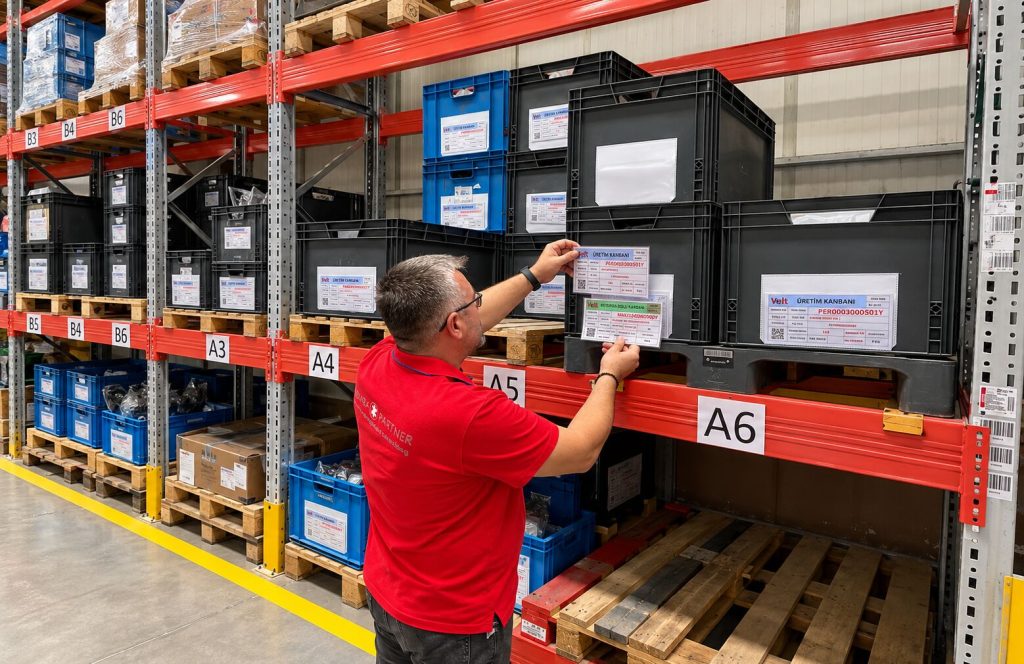
Kanban is the information carrier of JIT. These are visual signals showing which part, how much and when to produce. Thanks to these cards or digital signals, the “pull system” is kept under control.
Heijunka (Production Leveling)
For JIT to succeed, production volume and variety must be leveled over time. Heijunka spreads demand across the production process, preventing fluctuations and overloading of the system.
SMED
Quick die change (Single Minute Exchange of Die) is vital for JIT. If model changeovers take hours, producing in small batches becomes impossible. SMED ensures the agility of the system by reducing changeover times to minutes.
Supplier Integration
JIT does not end inside the factory. Suppliers also need to keep up with this speed and be part of the process with small batches and frequent deliveries. The supplier is no longer an external unit but an extension of the production line.
How Is Just in Time Production Implemented?
The transition to JIT does not happen overnight; it requires a disciplined roadmap.
Analysis of Current Processes
First, an “X-ray” of the current flow (Value Stream Mapping) is taken. Bottlenecks, waiting times and unnecessary inventory points are clearly identified.
Transition to a Pull System
The traditional “push” system, that is, producing based on forecast demand, is abandoned. Kanban loops are set up between stations so that each unit triggers the unit before it.
Production Line Balancing
Workloads must be distributed evenly across operations. “Just in time” production cannot be done in a structure where one station waits idle while another is overwhelmed.
Operator Training and Discipline
The margin for error is low in a JIT system. Operators being multi-skilled (able to run several machines) and gaining autonomous maintenance skills is essential for continuity of the system.
Common Mistakes in JIT Implementation
-
Not Preparing Suppliers: If you zero out inventory in your own factory but make trucks wait at your supplier’s door, you haven’t done JIT.
-
Neglecting Quality: In a stockless system, producing a defective part stops the entire line. If the quality system isn’t solid, JIT can turn into a disaster.
-
Expecting a Quick Fix: JIT is not a technique but a culture. It takes time for employees to adapt to this discipline.
-
Failing to Ensure Enough Discipline: Not following kanban cards or deviating from standard work processes quickly disrupts the flow.
The Relationship Between JIT and the Toyota Production System
JIT is one of the two main pillars of the Toyota Production System (TPS) (the other is Jidoka). In the 1950s, Japan’s limited resources and small market forced Toyota to find an efficient and flexible model instead of working with large inventories. JIT is considered the most important “productivity secret” that made Toyota a global giant, and today it forms the foundation of “Lean Manufacturing” worldwide.
The Place of Just in Time Production in Modern Industry
Today, with digitalization, JIT has evolved to the level of JIT 4.0 . Thanks to the Internet of Things (IoT) and real-time data analytics, suppliers can instantly see when a machine will need raw material. In today’s world of increasing demand for personalized products, the flexibility JIT offers is no longer an advantage for businesses but a basic requirement for staying in the global market.
Just in Time is a path to excellence. It must be remembered that inventory is “a blanket that covers problems.” As you reduce inventory, the rocks beneath the water (problems) become visible, and as you clear these rocks, your operation gains a much smoother flow.