What Is the Toyota Production System (TPS)? Core Principles and Tools
What is the Toyota Production System (TPS)? Its history, its two core pillars (JIT and jidoka), its basic principles and tools. Gemba Partner guide.
Short answer: The Toyota Production System (TPS) is the production and management system developed by Toyota that aims to eliminate waste, build quality into the process and drive continuous improvement. Its two core pillars are known as just-in-time production and jidoka (automation with a human touch, stopping defects at the source). It is the origin of lean production.
Introduction
Most of the concepts that come to mind when lean production is mentioned, kanban, 5S, kaizen, andon and poka-yoke, are in fact parts of the Toyota Production System. That is why understanding TPS means understanding the source of lean thinking.
In this article we cover the history of TPS, its core principles, its two pillars and the main tools it uses. For the general approach inspired by TPS, see our article What Is Lean Production as well.
A Brief History of TPS
The roots of TPS go back to Toyota’s founding family. The self-stopping loom developed by Sakichi Toyoda, which halts on its own when a thread breaks, is the source of the idea of jidoka (autonomation). Kiichiro Toyoda introduced the concept of just-in-time production — producing the needed part at the moment it is needed. Taiichi Ohno turned these ideas into a production system and developed it in Toyota’s factories, which had to work with limited resources. The spread of the system in the West as “lean production” came later, through subsequent research and publications.
The Two Pillars of TPS
| Pillar | Meaning | In practice |
|---|---|---|
| Just-in-time (JIT) | Produce what is needed, as much as needed, when it is needed | Pull system, kanban, takt time, flow. See What Is JIT |
| Jidoka | Detect the defect at its source and stop the process; build quality into the process | Andon, poka-yoke, separating machine and operator work, abnormalities becoming visible instantly |
Beneath these two pillars lie the elements that form the foundation of the approach: production leveling (heijunka), standard work and continuous improvement (kaizen).
The Core Principles of TPS
- The customer defines value. Any activity the customer is not willing to pay for is waste. See What Is Muda.
- Create flow. Work is meant to move without pauses, waiting or inventory.
- Pull system. Production is triggered by the next station’s call, according to customer demand.
- Stop and fix the problem. When a defect is seen the process is stopped and the root cause is solved.
- Standardization. Where there is no standard, there is no improvement.
- Continuous improvement. The goal of being a little better every day. See kaizen.
- Respect for people. The system relies on employees’ thinking and participation.
Main Tools Used in TPS
- 5S: An orderly and standardized workplace
- Kanban: The pull signal that governs material and production flow. See What Is Kanban.
- SMED: Quick changeover, shortening die and setup times
- Andon: A warning system that makes abnormalities visible
- Poka-yoke: Designs and devices that prevent errors
- Standard work: Putting the right method into written and visual form
- Value stream mapping: Making the waste in the flow visible. See VSM.
Can TPS Be Applied to Every Business?
TPS is less a toolbox than a way of thinking and managing. Copying the tools is easy, but building the culture the system rests on (making problems visible, involving employees in the process, continuous improvement) takes time and leadership. That is why successful implementations are not exact copies of Toyota but versions adapted to the business’s own product, scale and culture.
The Toyota Production System House
TPS is often shown in the shape of a house. On the roof are the goals (highest quality, lowest cost, shortest lead time); in the two pillars are just-in-time production and automation with a human touch (jidoka); and at the foundation are standard work, heijunka (production leveling) and continuous improvement. The strength of the house depends on its weakest element; therefore the tools should be treated as a whole, not one by one.
The Difference Between TPS and Lean Production
| Dimension | Toyota Production System | Lean Production (Lean) |
|---|---|---|
| Origin | Toyota’s own system | The generalized version of TPS in the West |
| Focus | Culture, people and system integrity | Adapting tools and methods |
| Scope | The whole system, from supplier to customer | Flexible according to sector and company |
Tips for Getting Started
Rather than copying TPS exactly, it is healthier to adapt its principles to your own context. First define customer value, then make flow and losses visible, create standard work and make improvement part of daily management. The first steps should be small, but consistency should be big.
How Do the Core Principles of TPS Look on the Floor?
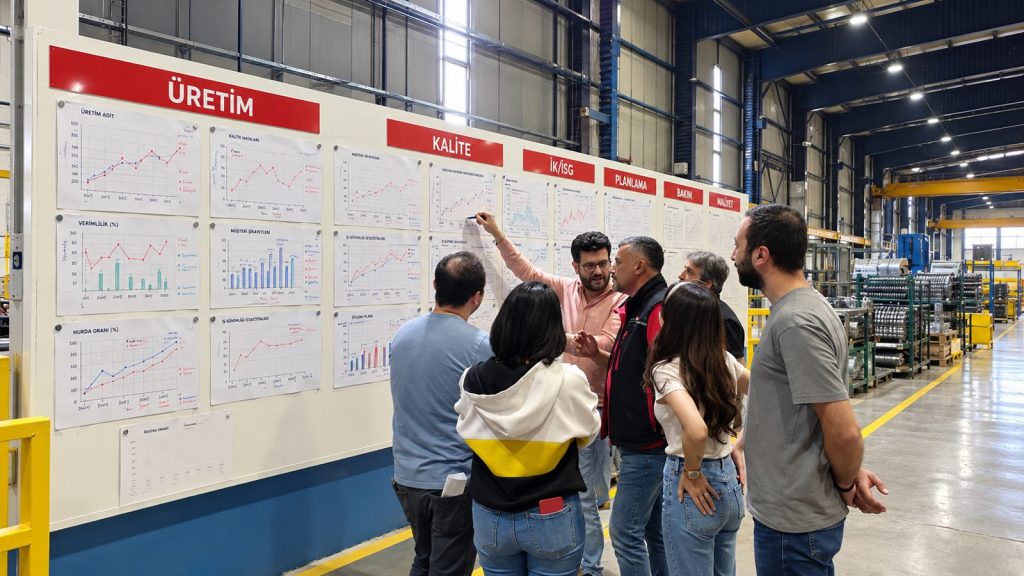
The best way to understand TPS is to look at what its principles look like on the floor. In just-in-time production, parts flow only when they are needed and in the quantity needed; this becomes visible through kanban cards and short batch sizes. In jidoka, when a problem occurs the machine or the operator stops the line, so the defective product does not pass to the next station. Standard work makes the best known method of every job written and visible; improvement is only possible if a standard exists.
Cultural Lessons Learned from Toyota
The strength of TPS comes more from its culture than its tools: making problems visible instead of hiding them, attributing errors to the process rather than to people, and making decisions close to the floor. This culture is built not by a campaign but by managers’ daily behavior. That is why the first question of companies trying to understand TPS should not be “which tool should we use?” but “how are problems met today?”
Points to Watch When Adapting TPS
- Context: Toyota’s mass-production conditions are not the same in every business; in low-volume, high-variety production the tools must be adapted.
- Supplier relationships: Just-in-time production cannot be sustained without a reliable supplier network.
- Time: Cultural change takes years; expecting short-term results leaves the implementation superficial.
Conclusion
The Toyota Production System is a management system that combines reducing waste, assuring quality within the process and continuous improvement. When its two pillars, principles and tools are considered together, it becomes clearer why lean production is a management approach rather than a “technique set.”
At Gemba Partner, we support businesses in applying the lean approach fed by TPS on the floor, adapted to their own conditions. To get in touch, click here..
Frequently Asked Questions
What is the Toyota Production System?
It is the production and management system developed by Toyota that reduces waste, builds quality into the process and is based on continuous improvement. It is the origin of lean production.
What are the two core pillars of TPS?
Just-in-time production and jidoka, that is, detecting the defect at its source, stopping the process and building quality into the process.
Are TPS and lean production the same thing?
Lean production is the name of the approach developed inspired by TPS and spread to other sectors. TPS is the source, while lean production is the generalized form of these ideas.
What are the most commonly used tools in TPS?
5S, kanban, SMED, andon, poka-yoke, standard work and value stream mapping are the main tools.
Who developed the Toyota Production System?
Toyota engineers and managers such as Taiichi Ohno, Shigeo Shingo and Eiji Toyoda developed the system over the years, starting in the 1950s.
Can TPS be applied to every sector?
The core principles (value, flow, pull, continuous improvement) can be adapted to many areas, including service, healthcare and office processes. What matters is carrying over the principles, not the tools, to your own context.
What does jidoka mean in TPS?
Jidoka means that the machine or operator stops the line when an abnormality is detected and the problem is solved at its source. This way a defective product does not enter the flow.
How long does TPS implementation take?
Setting up the tools takes months, but cultural embedding usually takes years; therefore it is recommended to start with a pilot area and progress gradually.