What Are Digital Management Tools? How to Choose the Right Tool in Production
What are digital management tools? Digital boards, OEE tracking, action management and MES tools in production, selection criteria and common mistakes.
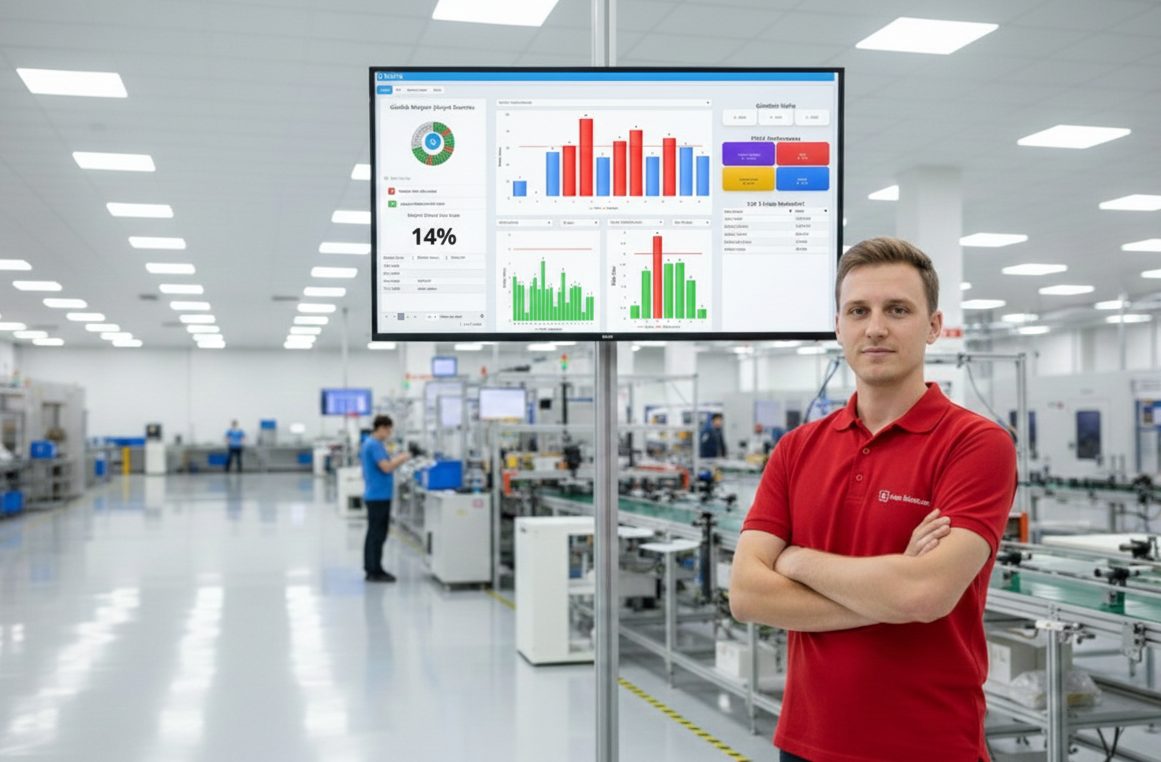
Short answer: Digital management tools is the general name for software and solutions that collect production and operations data from the shop floor and present it to managers and teams as indicators, boards and action tracking. Digital boards, OEE monitoring, action management, digital shop floor walks and manufacturing execution systems (MES) fall within this scope.
Introduction
Many companies begin their digital transformation journey by choosing a tool. But when the tool is chosen before the problem to be solved, it risks becoming an expensive, unused dashboard. Digital tools create value only when they accelerate the management system on the shop floor.
In this article, we cover what digital management tools are, which problems they address, selection criteria and common mistakes. For shop-floor-focused software in production, you can also read our article digital shop floor management programs .
Main Digital Management Tools
| Tool | What does it do? | Which problem does it address? |
|---|---|---|
| Digital board | Shows daily indicators and deviations on a single screen | Answers the question “What is our status today?” |
| OEE monitoring | Automatically collects equipment effectiveness and downtime causes | Makes visible where losses come from |
| Action management | Tracks actions with their owner and date | Prevents decisions from getting lost without being implemented |
| Digital shop floor walk and audit | Performs Gemba walks, 5S and safety checks with a mobile app | Prevents audit results from staying on paper |
| MES (Manufacturing Execution System) | Manages production orders, traceability and actuals | Shows the gap between planned and actual |
These tools can be used individually or together. What matters is that it is clear from the start which management problem each tool serves.
Questions to Ask Before Choosing a Digital Tool
- What is the problem first? Which decision is delayed because of which missing data?
- Is the process established? A process that doesn’t work even on paper won’t work digitally either.
- How will data be collected on the shop floor? Manual entry or machine connection? If the data is unreliable, the board will be unreliable too.
- Who are the users? If operators and foremen don’t use it, the tool turns into a management report.
- Integration with existing systems: Is data exchange with ERP and other systems possible?
Selection Criteria
- Ease of use on the shop floor (mobile compatibility, few clicks)
- Integration with existing ERP and machine data
- Adaptability of indicators and reports to the company
- Support for action tracking and assignment of responsibility
- Data security and access permissions
- Scalability: starting on one line and spreading to others
- The supplier’s support and training capacity
Common Mistakes
- Choosing a tool without defining the problem
- Not involving shop floor users in the process
- Creating too many indicators and screens
- Using the tool in place of the management system. A digital board produces no results without meeting and action discipline.
- Not starting with a small pilot instead of a big project
Which Data Should Be Tracked on a Digital Shop Floor Board?
The value of digital tools is measured not by the amount of data they collect but by the data that turns into action on the shop floor. A small number of clearly defined indicators is enough to start: output and deviation from target by line, unplanned downtime and its causes, quality rejection rate, number of open actions and closure time. The owner, update frequency and threshold value of each indicator should be set up front.
The 90-Day Pilot Approach
Launching digital transformation as a big project is risky. Instead, a 90-day pilot on a single line or department is recommended. In the first 30 days the existing data flow and loss points are mapped; in the second 30 days boards and meeting rhythm are put in place; in the last 30 days results are measured and a rollout decision is made.
- Select the pilot area and a single measurable target.
- Clarify the data source (machine, ERP, manual entry).
- Involve the shop floor team in the design of the board.
- Connect the short daily meeting to the board.
- On day 90, report gains and lessons learned.
Data Quality and Reliability
A board built on faulty data quickly loses the shop floor’s trust. Therefore validation rules at entry, a single-source-of-data principle and the responsibility of the person entering the data should be defined. When it is standardized who enters the data, when and how, reports produce decisions rather than arguments.
How Do You Measure Success?
The success of a digital tool is measured not by the number of screens but by behavior and results: reduced time spent on reporting, speed of action closure, reduction of downtime by cause and the rate of data-based decisions in meetings. These indicators should be measured before the pilot to create a baseline.
Conclusion
Digital management tools bring speed and transparency when built on the right management system. First define the problem, establish the process, start with a small pilot and put the shop floor user at the center of the process. A tool does not replace management discipline; it strengthens it.
At Gemba Partner, in our shop floor management and digital transformation work, we talk about the process first, then the tool. For our approach, see our field management and development system page or contact us.
Frequently Asked Questions
What are digital management tools?
They are software and solutions that collect production and operations data and present it as indicators, boards and action tracking. Digital boards, OEE monitoring, action management and MES are examples.
Is a digital board the same as MES?
No. A digital board visualizes indicators, while MES manages production orders, traceability and actuals. The two can also be used together.
What should be done before moving to a digital tool?
The problem to be solved should be clearly defined, the process should be established on the shop floor and the data collection method should be determined. Starting with a small pilot reduces risk.
Should small companies use digital management tools?
Yes, but it is better to start with simple solutions appropriate to the scale. It is generally healthier to first establish indicators and action discipline and then add tools.
Is Excel enough for digital shop floor management?
For a small scale and a single team, Excel is a good start. But when there are many lines, a need for real-time data and action tracking, digital shop floor management software provides speed, visibility and consistency.
Where should a digital tool investment start?
First the process and losses should be clarified, then the need that will create the most value should be validated with a small pilot. Choosing the tool comes after defining the problem.
Does digital transformation replace lean manufacturing?
No, it complements it. The lean approach determines which problem you will solve; digital tools make that solution fast, measurable and sustainable.