If crises are managed well, they bring opportunities with them.
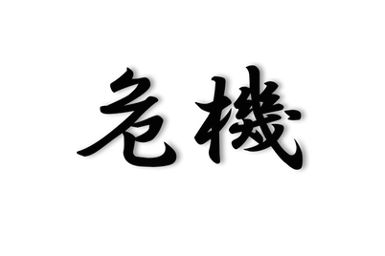
Did you know that the word for crisis in Japanese actually means dangerous opportunity?
It is read “Kiki.” Although its translation means crisis, in writing it is formed by placing the characters for danger and opportunity side by side. In short, the meaning given to crisis is “Dangerous Opportunity.””
In other words, according to the Japanese management understanding, crises are processes that carry risks but also have just as much potential to create a new opportunity. Whether you are affected by a crisis or create a new opportunity out of it depends entirely on how you manage the process.
Taiichi Ohno: the world needed a big shock like the oil crisis to notice Toyota.
This saying sums up the concept of dangerous opportunity in short.
When the development process of TPS is examined in detail, it stands out that all the methods it contains were developed in response to economic bottlenecks or problems brought about by competition. With this thinking, Kaizen looks at crises as opportunities and, instead of fearing a crisis, calls for fighting it. Crises bring economic bottlenecks with them. In economic problems, the main subject every company focuses on is reducing costs. Here, focusing on the production method rather than on the cost items of basic inputs will eliminate all our unnecessary labor and activities and will also automatically pull down the costs of basic inputs. So what are these opportunities? Although we could give many examples, let us examine the following ones.
| Impact of the Crisis | Impact Within Production | Opportunity Point |
| Cost per product rising because of fixed labor expenses | With a flexible line structure, absorbing fluctuations in production and employing only as many staff as needed | |
| Product processing time lengthening because of transport between processes, and non-value-adding labor costs rising because of transfer processes | Increasing the share of value-adding work by reducing transport and intermediate stock with sequential processes | |
| Income falling as sales volumes drop | Needlessly inflating costs with rework and quality control processes | Developing in-place quality practices so that quality is produced rather than controlled |
| Equipment whose investment cost has not yet been recovered not filling its capacity, machines unable to offer added value | Developing compact equipment and producing as much as needed with a minimum number of staff. | |
| Costs arising from inability to use time effectively because of unplanned stoppages such as breakdowns and changeovers | Converting idle time into active time through daily tracking of the 6 Big Losses, proactive maintenance and starting quick changeovers | |
| Staff who cannot see problems, are constantly absent and cannot ensure their own occupational safety | Training management emphasis to develop staff who can tell abnormal from normal and approach work accidents proactively |
When we see the problems in front of us as obstacles to overcome rather than accepting them, each problem will provide an extra output to our management processes.
While TPS argues that problems will always exist on the floor and therefore the struggle must never be abandoned, our country’s companies unfortunately accept the problems in front of their eyes, live with them and wait for them to be somehow solved. We need to learn to get through every crisis ahead of us against a changing environment, economic structure and bottlenecks, and to create opportunities out of danger. For this, the primary criterion is to accept that kaizen is a basic need and never to let go of the fighting spirit.
Remember that if, in your fight against waste, you see obstacles 10 cm high as a big problem, you will always give up at the first obstacle you face and get stuck on the danger of the crisis. You must learn to overcome obstacles and develop your team to teach them to overcome walls not 10 cm but 10 m high.
We wish you success in your struggle with crises.